
Inclined and ingrown nails
Kamogawa Clinic
Consultation and Access Information
Asahi Seimei Tenroku Building 2F, 6-3-16 Tenjinbashi, Kita-ku, Osaka 530-0041, Japan
TEL:06-6809-6088
Click here for access details
Physician Supervision and Editing
Dr. Yoshihisa Suzuki, Kamogawa Clinic
From the perspective of plastic surgery and dermatology practice, this article provides easy-to-understand explanations of symptoms, treatment methods, and guidelines for consultation for ingrown and ingrown nails.
Click here to see our doctors
The main points of this article
- Ingrown nails areNails curled inwardThe ingrown nail isNails dig into the skin and become inflamed.is.
- If there is redness, swelling, pus, granulation, or severe pain when walking, we recommend that you see a doctor as soon as possible.
- Depending on the condition, we will propose conservative treatment such as the wire method to the phenol method.
Table of Contents
- What symptoms of ingrown or ingrown nails should I see a doctor for in Osaka?
- What is the difference between an ingrown nail and a depressed nail?
- What are the causes of ingrown or ingrown nails?
- Can I fix it myself? Are there any first aid measures?
- What kind of treatment is provided at the hospital?
- case photograph
- Be careful to prevent reoccurrence.
- Frequently Asked Questions
- summary
What symptoms of ingrown or ingrown nails should I see a doctor for in Osaka?
If the toenail digs into the skin and becomes painful, red, swollen, or pusy, or if the granulation becomes raised, we recommend that you see a doctor as soon as possible.- Toenail digs into skin and hurts.
- Red and swollen on the side of the nail.
- Juiciness, pus
- Granulation is forming.
- Hurts strongly when it hits the shoe.
- It's hard to walk.
- Cutting myself doesn't improve it.
- Multiple recurrences.
What is the difference between an ingrown nail and a depressed nail?
An ingrown nail is "a change in the shape of the nail" and an ingrown nail is "a condition in which the nail digs into the skin, causing inflammation.An ingrown toenail is a condition in which the toenail curves laterally inward and inward. It can be painful, but is first and foremost a problem of nail shape. On the other hand, an ingrown toenail is a condition in which the ends or tips of the nail dig into the skin like spikes, causing pain and swelling. If the condition worsens, wounds may form, fester, and granulation may rise. Ingrown toenails often lead to ingrown toenails, where the nail ends tend to contact the skin. It is mainly found on the big toe (thumb) of the foot.Back to Table of ContentsWhat are the causes of ingrown or ingrown nails?
Deep nails, habitual cutting, ill-fitting shoes, and nail deformities are some of the causes.- Incorrect nail clipping causes spiky nails to dig into the skin.
- Deep nails, overcutting of nail corners
- Shoes that do not fit feet, pressure on toes
- Walking and lifestyle habits that make it difficult to put weight on the toes
- Age-related bony deformities of the toes
- Dry nails
- Nail changes due to athlete's foot, etc.
Can I fix it myself? Are there any first aid measures?
First aid may be helpful for mild symptoms, but if there is festering or granulation, do not continue self-treatment and seek medical attention.First aid by taping
This method involves gently pulling the skin on the side of the nail where the nail bites into the skin with an elastic-type tape to create a gap between the nail and the skin. If the condition is mild, it may be alleviated, but care should be taken because it can cause a rash.How to use cotton
A small amount of cotton is gradually stuffed between the ingrown nail and the skin to lift the nail. This method alone rarely completely cures the problem, although it may lead to a reduction in pain.Points to note for self-care
Back to Table of Contents- Forcibly cutting the corner of the nail may make it worse.
- Do not continue self-treatment if severe pain, redness, pus, or granulation is present.
- Self-care is only a first aid measure, and treatment tailored to the cause is important to prevent recurrence.
What kind of treatment is provided at the hospital?
Treatment of ingrown or ingrown nails is chosen based on the shape of the nail, the presence of inflammation, suppuration, granulation, and recurrence.We will explain the conservative and surgical treatment options available to you, depending on the condition. For treatment of ingrown or ingrown nails, a consultation with a plastic surgeon or dermatologist is useful.Treatment by wire method
The wire method is an option for gradual correction of nail kyphosis.This is a corrective treatment in which a hyperelastic wire is attached to the nail and the force of the wire's return to its original shape lifts the nail that has dug into the skin. It is simpler than surgery, but requires a certain period of time for improvement. However, it may not be indicated in cases of suppuration or granulation.Treatment by phenol method
The phenol method is an option for radical treatment in cases of repeated recurrence or high inflammation.After local anesthesia is administered, the end of the ingrown nail is partially treated, and if necessary, the nail matrix is treated with phenol. By treating the part of the nail that creates the nail, the ingrown nail becomes less likely to grow back, thus preventing recurrence.Guideline for choosing a treatment
Back to Table of Contents- Wire method:Corrective treatment when suppuration and granulation are not strong
- Phenol method:Radical treatment options for severe pain, recurrence, difficulty walking, and high inflammation
case photograph
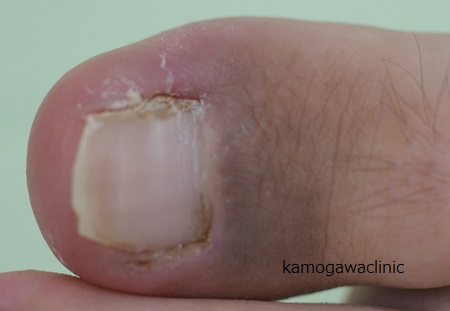
Ingrown and ingrown nails may look similar, but the degree of inflammation and the need for treatment differ.Case photos are helpful in understanding the extent to which the patient should be seen and the type of treatment that is likely to be required.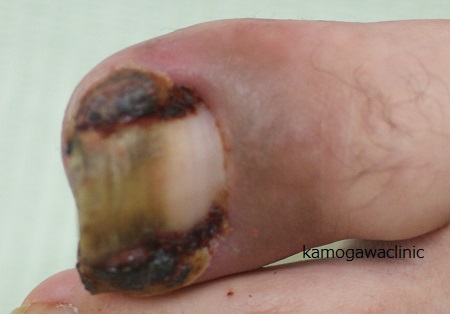
Be careful to prevent reoccurrence.
To prevent recurrence, it is important to review nail trimming, shoes, and stress on the toes.- Avoid deep nails and do not cut nail corners too far.
- Choose shoes that do not hit the toes hard.
- Avoid excessive stress on the toes
- If the nails are deformed or dry, consult as soon as possible.
Frequently Asked Questions
Are ingrown and ingrown nails the same?
They are not the same. An ingrown nail is a problem with the shape of the nail, while an ingrown nail is a condition in which the nail digs into the skin and becomes inflamed. An ingrown nail can cause an ingrown nail.Can I see a doctor even if I have an abscess?
Yes, if you have any redness, swelling, pus, or granulation, please consult with us. Redness, swelling, pus, or granulation should also be consulted. Early consultation is recommended as self-treatment may worsen the condition.Can it be cured by cutting my own nails?
Deep nails or over cutting the corners can make it worse. It is safer not to force a cut, especially if there is pain or inflammation.Is surgery always necessary?
Surgery is not always necessary in all cases. Depending on the shape of the nail, the degree of inflammation, and the presence or absence of recurrence, conservative treatment may be indicated.Where should I see for ingrown or ingrown nails?
Depending on the condition, a plastic surgeon or dermatologist may be helpful. If there is pain or festering, please consult your health care provider as soon as possible.Will it be covered by insurance?
As it depends on the medical condition and treatment, this will be explained at the time of consultation.What department should I see for ingrown or ingrown nails in Osaka?
Ingrown and ingrown nails are often consulted by a plastic surgeon or dermatologist. Early consultation is recommended if pain, swelling, festering, or granulation is present. We will assess the condition and suggest treatment according to the symptoms. Back to Table of Contentssummary
While ingrown and ingrown nails are relatively easy to deal with when mild, if left untreated they can lead to pain, festering, granulation, and difficulty walking.Rather than just self-treatment and watching the condition for a long time, receiving treatment for the condition is a shortcut to improvement. For treatment of ingrown or ingrown nails near Tenjinbashisuji Rokuchome Station in Kita-ku, Osaka, please contact us at Kamogawa Clinic Tenroku.Consultation and Access InformationClick here for accessClick here to see our doctorsKamogawa Clinic Tenroku Top Page
Physician Supervision and EditingKamogawa Clinic Dr. Yoshihisa Suzuki treats toe problems including ingrown toenails and ingrown nails from the perspective of plastic surgery and dermatology practice.Click here for the doctor introduction page
Published: August 16, 2022 / Last updated: April 10, 2026Kamogawa Clinic Tenroku / Asahi Seimei Tenroku Building 2F, 6-3-16 Tenjinbashi, Kita-ku, Osaka 530-0041, Japan / TEL: 06-6809-6088