
Ingrown toenails
Kamogawa Clinic Tenroku
Contact & access 2F Asahi Seimei Tenroku Bldg., 6-3-16 Tenjinbashi, Kita-ku, Osaka 530-0041, Japan Phone: +81-6-6809-6088 (06-6809-6088 within Japan) Open in Google Maps
Medically reviewed by Yoshihisa Suzuki, MD, PhD, Director, Kamogawa Clinic (board-certified plastic surgeon) This page explains the symptoms of ingrown toenails, how they differ from pincer nails, treatment with the phenol method, and when to see a doctor, from the perspective of plastic surgery and dermatology. Our doctors (Japanese)
Key points
- An ingrown toenail is a nail that digs into the skin and causes inflammation. A pincer nail is a nail that curves inward from the sides.
- If you have redness, swelling, pus, granulation tissue or strong pain when walking, we recommend seeing a doctor early.
- We treat ingrown toenails with the phenol method. We do not offer treatment to correct the curve of a pincer nail, such as wire bracing.
Contents
- When should I see a doctor for an ingrown toenail in Osaka?
- What is the difference between an ingrown toenail and a pincer nail?
- What causes ingrown toenails?
- Can I treat it myself? Is there any first aid?
- How do we treat ingrown toenails?
- Case photos
- Preventing recurrence
- Frequently asked questions
- Summary
When should I see a doctor for an ingrown toenail in Osaka?
See a doctor early if your toenail is digging into the skin and hurts, the area is red and swollen, pus is coming out, or a raised lump of tissue (granulation tissue) has formed.- The nail of your big toe is digging into the skin and hurts
- The skin beside the nail is red and swollen
- The area is weeping or there is pus
- Granulation tissue has formed
- It hurts badly when your shoe presses on it
- Walking is painful
- Trimming the nail yourself hasn’t helped
- It keeps coming back
What is the difference between an ingrown toenail and a pincer nail?
An ingrown toenail is a nail that has dug into the skin and caused inflammation. A pincer nail is a change in the shape of the nail.An ingrown toenail (kannyuso, 陥入爪 in Japanese) is a condition in which the edges or tip of the nail dig into the skin like a thorn, causing pain and swelling. As it gets worse, a wound can form and become infected, and raised granulation tissue may develop.A pincer nail (makizume, 巻き爪) is a toenail that curves inward from side to side. It can be painful, but it is first and foremost a problem with the shape of the nail.Because a pincer nail makes it easier for the edge of the nail to press into the skin, it often leads to an ingrown toenail. Both are most common on the big toe.In everyday English, both conditions are often simply called “ingrown toenails.” Doctors tell them apart because the right treatment can differ.Back to contentsWhat causes ingrown toenails?
Common causes include cutting nails too short or rounding off the corners, shoes that don’t fit, and changes in the shape of the nail, such as a pincer nail.- Incorrect nail trimming that leaves a sharp spike of nail digging into the skin
- Cutting nails too short, or cutting the corners too deeply
- Shoes that don’t fit, or pressure on the tips of the toes
- A way of walking or daily habits that put little weight on the toes
- Changes in the toe bones with age
- Dry nails
- Nail changes caused by nail fungus or other conditions
Can I treat it myself? Is there any first aid?
First aid can help with mild symptoms, but if there is pus or granulation tissue, stop treating it yourself and see a doctor.First aid with taping
Using stretchy tape, gently pull the skin on the side where the nail is digging in away from the nail, creating a small gap between the nail and the skin. In mild cases this may ease the symptoms, but the tape can irritate the skin, so take care.Using cotton
Tuck small amounts of cotton, a little at a time, between the skin and the part of the nail that is digging in, to lift the nail. This can help reduce pain, but it rarely cures the problem on its own.Things to watch out for with self-care
- Forcing yourself to cut the corner of the nail can make it worse.
- If you have strong pain, redness, pus or granulation tissue, do not keep treating it yourself.
- Self-care is only first aid. Preventing recurrence requires treatment that addresses the cause.
How do we treat ingrown toenails?
At our clinic, we treat ingrown toenails with the phenol method. We decide whether it is suitable after examining the shape of the nail, any inflammation, infection or granulation tissue, and whether the problem has come back before.Ingrown toenails are well suited to examination by a plastic surgeon or dermatologist. We do not offer treatment to correct the curve of a pincer nail, such as wire bracing.The phenol method
The phenol method addresses the underlying cause of an ingrown toenail and is an option when the problem keeps coming back or the inflammation is severe.After a local anesthetic, the edge of the nail that is digging in is partially removed, and the nail matrix (the part that produces the nail) is treated with phenol as needed. This procedure is also known as chemical matrixectomy. Treating the nail matrix makes it harder for the ingrown part of the nail to grow back, which helps prevent recurrence.When the phenol method may be considered
- The pain is severe
- The ingrown toenail keeps coming back
- Walking is difficult
- The inflammation is strong
In practice, we decide after examining your nail. Please don’t force yourself to cut the nail. Talk to us first.
Case photos
Ingrown toenails can look similar, yet differ in how inflamed they are and in what treatment they need.Case photos can help you understand when it is time to see a doctor and what kind of treatment may be needed.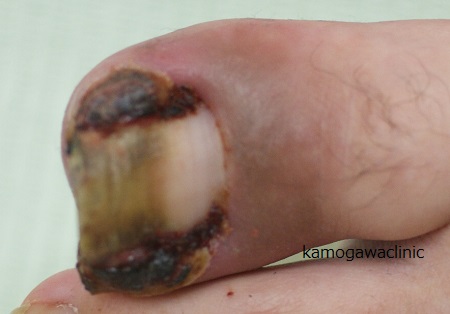
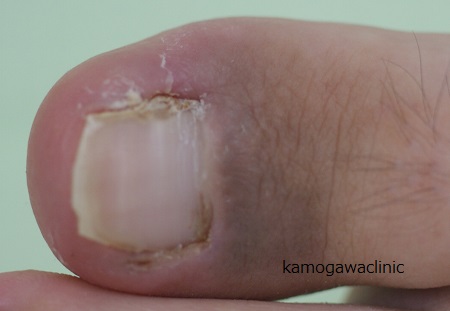
About this case
- Treatment: Phenol method (partial removal of the ingrown nail edge and treatment of the nail matrix with phenol) under local anesthesia, as outpatient day surgery
- Cost: 10,000-20,000 yen
- Main risks and side effects: pain after the anesthetic wears off, oozing from the treated area for a few weeks while it heals, infection, recurrence, and the nail becoming narrower than before
Results vary from person to person.
Preventing recurrence
To prevent recurrence, review how you trim your nails, the shoes you wear, and the strain on your toes.- Avoid cutting nails too short, and don’t cut the corners too deeply
- Choose shoes that don’t press hard on your toes
- Avoid putting excessive strain on your big toe
- If your nails are very misshapen or dry, see a doctor early
Frequently asked questions
Are a pincer nail and an ingrown toenail the same thing?
No. A pincer nail is a problem with the shape of the nail, while an ingrown toenail is a nail that has dug into the skin and caused inflammation. A pincer nail can lead to an ingrown toenail.Do you treat pincer nails or offer nail braces?
No. We do not offer treatment to correct the curve of a pincer nail, such as wire bracing or other nail braces. If the nail has dug into the skin and become an ingrown toenail, please consult us.Can I be seen if it’s infected?
Yes. Please contact us even if there is redness, swelling, pus or granulation tissue. Treating it yourself can make it worse, so we recommend seeing a doctor early.Will it get better if I cut the nail myself?
Cutting the nail too short or cutting the corners too deeply can make it worse. If there is pain or inflammation, it is safer not to force yourself to cut it.Will I definitely need the phenol method?
Whether the phenol method is needed depends on how far the nail digs in, how inflamed it is and whether it has come back before. We examine your toe and explain whether the phenol method is suitable for you.Where should I go for an ingrown toenail?
It depends on your condition, but an examination by a plastic surgeon or dermatologist can help. If there is pain or infection, please see a doctor early.Is treatment covered by health insurance?
It depends on your condition and the treatment, and we will explain this at your consultation. If you are enrolled in Japanese health insurance, please bring your health insurance card, or your My Number Card if it is registered for health insurance use. If you are not enrolled in Japanese health insurance, a different fee schedule applies, and we will explain the approximate cost at your visit.Which department should I see for an ingrown toenail in Osaka?
In Japan, ingrown toenails are usually seen by plastic surgery or dermatology. Podiatry, which often handles these problems in the US, is not a separate licensed profession in Japan. If you have pain, swelling, infection or granulation tissue, we recommend seeing a doctor early. At our clinic, we examine your toe and explain the treatment suited to your symptoms.Back to contentsSummary
Ingrown toenails are relatively easy to manage while they are mild, but left untreated they can lead to pain, infection, granulation tissue and difficulty walking.Rather than waiting it out with self-care alone, getting treatment suited to your condition is the better path to improvement. If you are looking for ingrown toenail treatment near Tenjimbashisuji 6-chome Station in Kita-ku, Osaka, please contact Kamogawa Clinic Tenroku.Contact & access
Phone: +81-6-6809-6088 (06-6809-6088 within Japan) Message us on LINE
Appointments are recommended. If this is your first visit, calling before you come makes things go more smoothly. Patients with urgent problems are also seen.
Tenjimbashisuji 6-chome Station (Osaka Metro Sakaisuji and Tanimachi lines), Exit 3, about 1 minute on foot
Open in Google Maps Access details (Japanese) 日本語ページ(Japanese version of this page) Kamogawa Clinic Tenroku home (Japanese)
Medically reviewed by
Yoshihisa Suzuki, MD, PhD Director, Kamogawa Clinic · Board-certified plastic surgeon
Dr. Suzuki graduated from the Kyoto University Faculty of Medicine and holds a PhD in medicine. He has served as Chief of Plastic and Reconstructive Surgery at the Kyoto University Graduate School of Medicine and as the first Specially Appointed Professor in the Department of Plastic Surgery at Shiga University of Medical Science. At Kamogawa Clinic, he treats foot and toe problems, including ingrown toenails, from the perspective of plastic surgery and dermatology.
Published: October 23, 2026Kamogawa Clinic Tenroku / 2F Asahi Seimei Tenroku Bldg., 6-3-16 Tenjinbashi, Kita-ku, Osaka 530-0041, Japan / Phone: +81-6-6809-6088